

02 April 2026
The Untamed History of the Brazos River, Texas
There is a river that has defined Texas longer than Texas has defined itself.
It carves through the heart of the state with quiet authority, winding past limestone bluffs, ancient forests, and cathedral-canopied bottomlands. Unhurried, unimpressed, and absolutely unapologetic. It has swallowed settlements and fed civilizations. It has drawn explorers to their knees and carried cotton bales to the Gulf. It has been named holy, been diverted, been fought over, and through all of it, it has kept moving.
The Brazos River does not ask permission.
To understand the Brazos River, Texas is to understand the soul of this state: wild, fertile, contested, beautiful, and deeply, stubbornly alive. Its history is not a quiet one. If you are paying attention, it is still being written today.
The Arms of God: How the Brazos Got Its Name
The story begins with thirst.
Spanish explorers pushing north through the coastal plains of what would become Texas found themselves in desperate straits. Days into a march with no water, the sun unrelenting, the land offering nothing. When they finally stumbled onto the banks of a wide, winding river, it was less discovery and more salvation. Falling to their knees at the water’s edge, they named it El Rio de los Brazos de Dios: The River of the Arms of God.
That name has never fully left the water.
Stretching over 840 miles from its headwaters in eastern New Mexico down through the rolling plains, cross timbers, and coastal prairies of central Texas to the Gulf of Mexico, the Brazos River, Texas is one of the longest rivers in the entire country. It drains more than 45,000 square miles of land, nearly a third of the state, and passes through landscapes as wildly varied as the high desert plains of the Panhandle, the rolling post-oak savannahs of the Hill Country corridor, and the lush, dark river bottomlands of Central Texas. It is not one river so much as many rivers sharing the same name, each stretch carrying its own character, its own pace, its own stubborn identity.
It has always been, in every sense, the arms that hold Texas together.
The First Peoples of the Brazos
Long before the Spanish knelt on its banks, the Brazos was already ancient with human history.
The Wichita, Caddo, Tonkawa, and Comanche peoples all knew this river intimately — its seasonal floods, its fishing runs, its game-rich bottomlands, and the thick timber that lined its banks like a natural cathedral. For thousands of years, the Brazos was not a landmark or a boundary. It was a lifeline, and the nations who lived along it understood it the way you understand something you have never taken for granted.
The Wichita people built permanent villages along the upper reaches of the river, farming maize and trading across a network that stretched throughout the Southern Plains. The Caddo, further east, constructed elaborate earthen mounds along its tributaries and cultivated one of the most sophisticated pre-Columbian cultures in the American interior — their oral traditions, their trade routes, their agricultural knowledge all oriented around the rhythms of the water. The Comanche, who arrived later on horseback, claimed the river’s central stretches as part of their vast territory, riding its corridors with a freedom that even today is difficult to fully imagine.
These were not people passing through. They were stewards. The river fed them, connected them, and shaped the cadence of their lives for millennia before the first European boot print appeared on its banks. When the Spanish arrived, and later the Anglo settlers, they were not entering an empty wilderness. They were entering a landscape that had already been carefully, intentionally tended for generations.
The Republic, the Cotton, and the Cattle
When Stephen F. Austin arrived in Texas in the 1820s to lead the first organized Anglo-American colony, his choice of location was not accidental. He settled the Brazos River valley because the land was extraordinary. The rich black clay soils of the Brazos bottomlands — built up by centuries of flooding and the slow decomposition of hardwood forest — were among the most productive in all of North America. Cotton took root here almost immediately, and by the time Texas won its independence from Mexico in 1836, the Brazos corridor had become the economic backbone of the new republic.
The river itself became a highway. Steamboats navigated its lower reaches, carrying bales of cotton down toward the Gulf and bringing dry goods and supplies back upstream to growing settlements in the interior. Towns rose directly from its banks. Washington-on-the-Brazos — where the Texas Declaration of Independence was signed in March of 1836 — staked its entire identity to the water beside it.
Falls County, in the Central Texas heart of the river valley, became a center of this agricultural prosperity. Named for the dramatic limestone falls where the Brazos narrows and tumbles over ancient rock formations, the county grew up around the rhythms of the water and the demands of the land. Communities like Satin, Texas — nestled quietly in the Brazos bottomlands — were built by families who understood that their fate and the river’s were inseparable. After cotton came cattle, and after cattle came the ranching culture that still defines much of Central Texas today: hardworking, land-proud, and deeply rooted in the soil along the river’s edge.
A River Under Pressure
The qualities that made the Brazos so essential to human settlement are the same qualities that have put it under enormous strain.
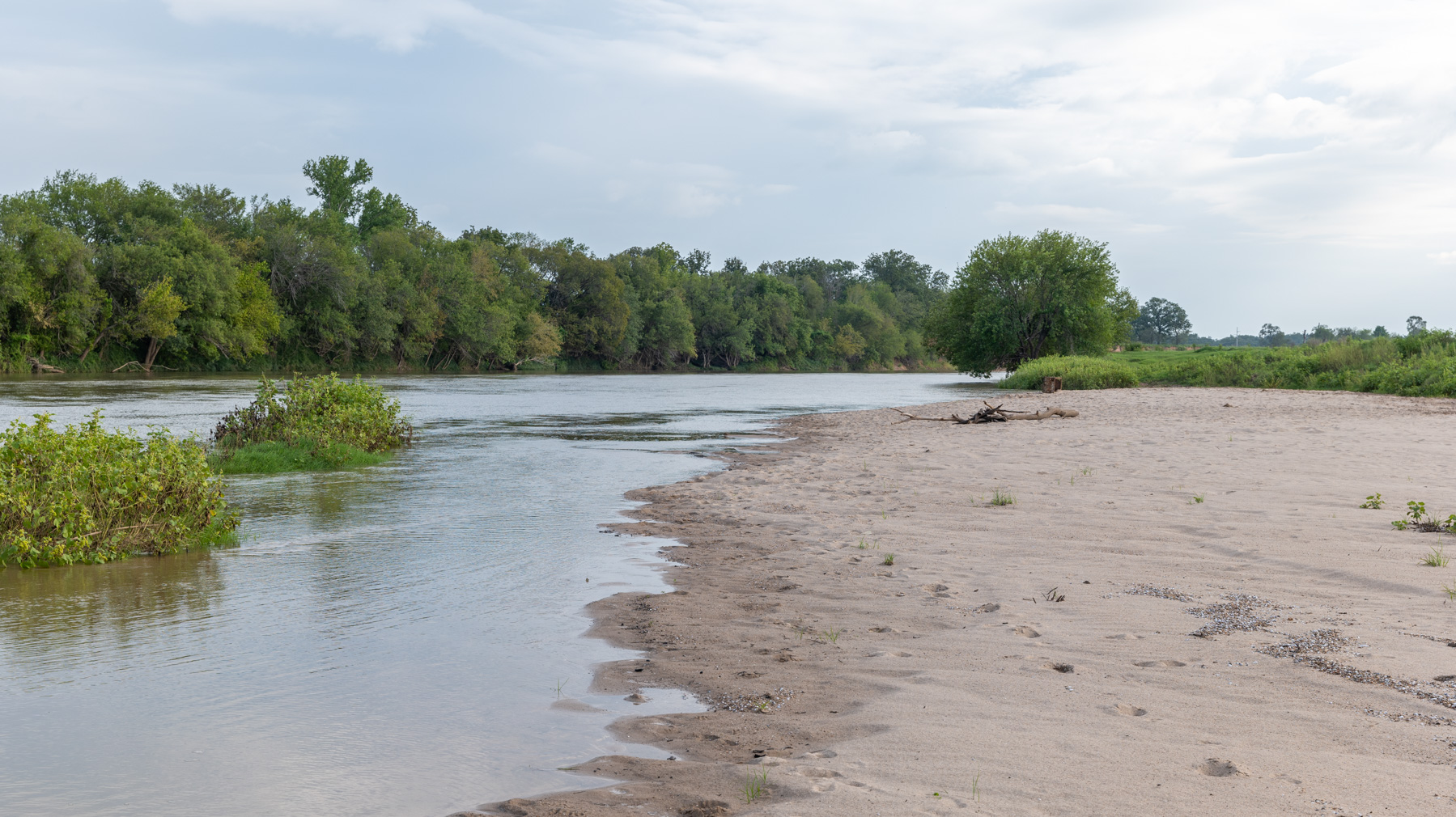
Today, the Brazos faces serious conservation challenges. Agricultural runoff, urban development, water diversions for municipal use, and recurring cycles of severe drought have all taken a heavy toll on the river’s ecosystem. Stretches that once teemed with native fish, migratory waterfowl, and riverbank wildlife have been diminished by a century of pressure. The bottomland hardwood forests that once blanketed the river’s edges have been largely cleared for development and agriculture. The white-sand beaches and clear, slow-moving channels that once characterized the river’s most beautiful stretches are increasingly difficult to find.
The wild spirit that once drove Spanish explorers to name this water after the hands of God has, in too many places, been quieted.
But not everywhere.
There are still stretches of the Brazos River, Texas where the water runs cold and clear through curtains of cypress. Places where the whitetail deer come down to the banks at dusk, where great blue herons stand motionless in the current, and where the river still has the authority to remind you — quietly, irresistibly — that you are a guest here. That the land was not made for you. That you are, at best, a very lucky visitor to something much older and much larger than yourself.
Those places are worth protecting. And some people are doing exactly that.
Moon River Ranch: Where the River’s Story Continues
One of those places is Moon River Ranch.
Situated along a rare and protected stretch of the Brazos in Satin, Texas, Moon River Ranch is not simply a resort. It is a working conservation sanctuary. 550 acres of riverland committed to being preserved, not developed. With 6.5 miles of protected river frontage and a three-mile stretch of pristine white-sand Brazos beachfront that is nearly impossible to find anywhere else in the state, the ranch represents something increasingly precious: a living piece of the river the way it is supposed to be.
This is not a coincidence. The mission at Moon River Ranch is rooted in a conviction that the health of the Brazos River is inseparable from the health of everything around it — the wildlife, the land, the guests, and the generations who will come after all of us. The ranch’s 550-acre grounds are home to over 500 wild animals, including zebras, wildebeests, and oryx, managed with a deep commitment to ethical, sustainable wildlife stewardship. The river frontage is actively maintained. The beachfront is protected. The wild things here are given the space and the commitment to remain wild.
For visitors, Moon River Ranch offers something no standard Texas resort can replicate: the chance to experience the Brazos the way it has always deserved to be experienced: from inside a living, breathing ecosystem that someone is working hard to keep alive. Whether you are kayaking through clear river current, riding horseback along the bank at golden hour, or simply watching the water from a riverside chair as the sun drops below the pecan canopy, you are not a tourist consuming a landscape. You are a participant in a conservation story.
You are not just a guest at Moon River Ranch. You are a witness to something being protected.
The River Always Remembers
The Brazos has survived everything Texas has thrown at it: drought, flood, war, settlement, industry, neglect. It has given this state its soul and asked for very little in return. What it has asked for, when it has asked for anything at all, is stewardship: the willingness of those who live and play along its banks to protect what they have been given.
At Moon River Ranch, that is the whole point.
The history of the Brazos River is not a story that ends. It is a story that keeps going, through every generation that chooses to protect it. Come be part of it.
Plan your stay at Moon River Ranch Resort & Safari in Satin, Texas.